Thursday, May 3, 2012

Winter's contrasts

Well, Winter is officially here now after the last week of cold fronts and some good rain in the Western Cape. I had my first low-level temperature alarm the other night in the greenhouse signalling the coldest night so far this year. I have been taking advantage of the cold clear nights after the cold fronts to shock my Dendrobium nobile and D. tortile into flowering. They have been hung outside the greenhouse at night to appreciate the chilly weather and have responded with some good leaf drop. I also quite by acccident noticed that my D. goldschmidtianum was budding as a result of the cooler conditions. I am looking forward to these blooms!
Dendrobium nobile
Dendrobium tortile

Dendrobium goldschmidtiaum buds
D. goldschmidtianum close up
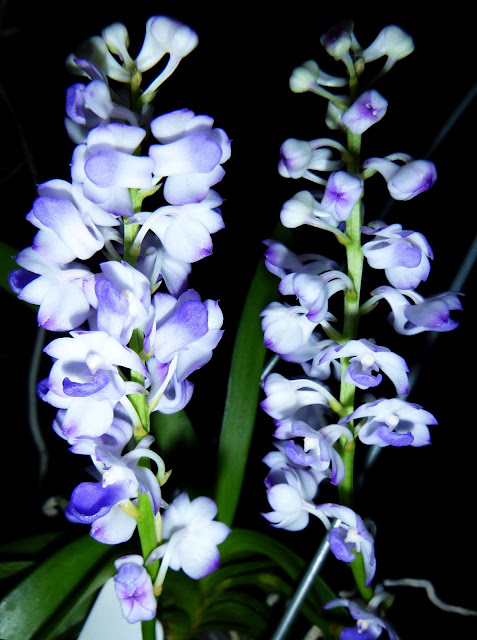
So, while some plants are getting ready for their winter rest period, others are just beginning to send out new flower spikes. I have been keeping a close eye on my Holcoglossum wangii which has pushed out a single spike (its first ever). The buds are developing well. This species is particularly beautiful and is also a relatively recent discovery having been described as late as 1998. It is found in China and North Vietnam. Just South (literally) of my H. wangii on my mount wall is my Phalaenopsis lowii which has been indecisive it seems over the last few months. Finally it has settled in I think and has produced a new leaf or two as well as a short, developing flower spike. The plant is still really small so I am skeptical if it will flower properly - we will see.
Holcoglossum wangii budding
Phalaenopsis lowii spike
The Dendrochilum that Bradley gave me is flowering now too. The flowers are very delicate and look like they have been made out of ice. I am still unsure of whether I like or dislike the powerful fragrance that the flowers give off during the day. It is a mix of sickly-sweet and spices, an odd mix and a bit overpowering if you get too close. I am struggling to identify the species. I initially thought that it could be Dendrochilum magnum but after reading some facts about their taxonomy it appears as though this is not as easy as it seems. I will wait until more flowers open and I may then send some photos around to get a consensus. Other flowers that are just beginning to open now are Polystachya titan and Prosthechea cochleata (Anacheilium cochleatum).

Dendrochilum sp.
Prostechea cochleata
Polystachya titan


Sunday, April 29, 2012

Ascofinetia, Epidendrums and a frog!

I got an Ascofinetia hybrid four yeasrs ago while I was living in J bay. It has been a healthy strong plant since I have had it and seems to adapt to various climate  situations very well. I got this plant labelled as Ascofinetia Peaches which is all good as it had light orange flowers when it first flowered in my care and another spike of orange flowers the second time. Last year it did not flower as we moved from J Bay to Cape Town and then to Worcester where it is now happy in its little corner of the shade house and has rewarded me with some flowers. This time around though they are more on the purple side and not the light orange they normally are. I am not complaining as I like the variation.

Ascofinetia Peaches( Neofinetia falcata x Ascocentrum curvifolium )


Ascofinetia Peaches
Also a plant I have been excited about has finally flowered for me recently. I am still not 100% sure which species it is but it definitely belongs to the genus  Epidendrum. It is a good size specimen plant with canes about 60- 70cm long. Flowers are produced from terminal spikes that re flower from bract's the following season making an impressive display on the long canes.
Epidendrum sp.
Epidendrum sp.
The well known poor mans orchids are very common in gardens in South Africa and are a bit overlooked in the orchid community. I grow them in pots outside the shade house in the garden. They are almost always in flower and make great specimen plants if grown in hanging baskets or in the garden near a tree.


This tall grass like African species Neobenthamia has flowered recently.
Neobenthamia gracilis
Last but not least two long flower spikes. Waiting in anticipation :)
Laelia anceps 600mm spike
Angraecum eburneum 1100mm spike 12 flowers


I also found this little frog Hyperolius horstocki in a wild garden in Bettys Bay this last weekend. This pic just does not do it justice as it is a brightly colored light brown and orange guy with black stripes down the sides of the body, one from the tip of the nose and the other from the eye. A dark brown coloring in between the two stripes fades midway to the back of the frog.

Hyperolius horstocki (Arum lily frog)
For side view click below:


Tuesday, April 17, 2012

Mounting Laelia anceps

It has been some time since my last post on the blog, partly because my plants have slowed down significantly in the greenhouse with the onset of the colder weather this Autumn, and partly because I am preparing to move to a new farm in the next few months. Preparing to move all my plants is rather stressful and to make things worse is that they will be moving in Winter and the greenhouse will have to be dismantled and re-built. The plants will be living in the garage during this time and although they will probably take a knock, I am hoping that some heating and some good lighting in the garage during this time will be enough to see them through.

I had recently been eyeing out some long mats of aerial roots descending from lateral branches of some mature Ficus sp. in Stellenbosch at a facility which I visit on a monthly basis for training as part of my job. I took a hacksaw blade along with me and asked permission to remove two of these mats. I was keen to see if they would make for good mounts for orchids - they cerytainly look interesting! I decided to try a large seedling of Laelia anceps mounted on a section of one of these mats.

Preparing to mount Laelia anceps
I removed the Laelia anceps from its small pot and checked for signs of new roots. I positioned the roots of the Laelia anceps beneath a layer of some of the longitudinal rows of aerial roots which make up the mat from the Ficus sp. and secured it with fishing line. I then threaded a piece of galvanised wire through the top of the mat and secured it at the back, allowing for a hook to be attached. The mount was then strung up on one of my mount walls in the greenhouse. I hope the plant likes the mount. I am keen to try some other species on the same material, especially some Dendrobiums when they are large enough.

Ficus sp. aerial root mat
Laelia anceps seedling with new roots
Laelia anceps mounted
The colder night temperatures should soon start to influence my Dendrobium nobile. It has just started to lose a few leaves now and I have reduced its watering regime to dry it out. I hope it flowers for me this year. Some of the other plants that flowered late last year that I hand pollenated have produced some good pods that are just about ready for harvesting now. In fact, the Cyrtorchis chailuana pods I harvested just the other day when they turned a lovely shade of yellow. They were full of viable seeds and I have sown several mother flasks which I hope will germinate out. Other pods include Oncidium sphacelatum that will be ready at the end of April and Ascocenda hybrids with Rhynchostylis coelestis and Phalaenopsis aphrodite.

Dendrobium nobile
Ascocenda hybrid pods
Oncidium sphacelatum pods
Cyrtorchis chailuana pods

Thursday, March 22, 2012

Dendrobium ravanii: the story and progress

Dendrobium ravanii is a small-sized epiphytic Dendrobium species endemic to Mindoro Island in the Philippines. It is only found in the North of the Island in the mountains in heavy shade. It was described as early as 2008 by Jim Cootes and named after Ravan Schneider who found the type specimens and who lives on the Island. According to the original description by Cootes, the numerous flowers are about 3cm wide and 3.4cm long and arise from a short pendulous inforescence.

In March 2011 I received some dry seeds from a friend of mine from Germany who had just returned from Mindoro Island. He had been given Dendrobium species seeds from a private collection on the Island. He did not recall the species of the Dendrobium seeds that he had sent me unfortunately but at that stage I wasn't really concerned and was happy to attempt to germinate them anyway for my collection. The seeds took 42 days to germinate but the percentage of success was high. The protocorms were very small and took a further few months to differentiate into tiny seedlings. My curiosity grew with the seedlings... I wondered what on Earth they could be. None of my other little Dendrobium species I had sown looked quite like this species in flask although it was classically a Dendrobium given the shape of the developing canes and the leaves. These seedlings were much more delicate, much smaller with very long thin delicate roots. My curiosity finally got the better of me and I began to research which species it could possibly be. I began to hunt for a list of species that grows on Mindoro Island and during this search I came accross the description of D. ravanii. The other species listed that grow on the Island I had in flask already and none of them looked quite like my mystery species.

I contacted Jim Cootes in Australia and explained my curiosity to him and asked if he knew of anyone who had done any molecular work on the species or if he knew of a published or unpublished neucleotide sequence for D. ravanii which I could use for a comparison. Unfortunately he explained that only he and Ravan Schneider had the species in cultivation and that he was not aware of any molecular work that was being done on the species. Jim was kind enough to offer to contact Ravan on Mindoro to ask him if he recalled his meeting with my friend on the Island and whether he could confirm the species of the Dendrobium seeds he had given him. A few days later I received an email to inform me that Ravan recalled meeting my friend and that the species given to him was most likely D. ravanii. So, I need to wait now to flower the species in the next few years to come to confirm its identity but Jim suggests that this won't take long because D. ravanii flowers from small plants.

Protocorms on 21 August 2011
March 2012
Currently I have numerous flasks of developing seedlings that are growing well. I re-plated another mother flask of them last night into their final flasks for growing out before hardening them off later this year hopefully. I intend to mount these onto small rafts and will then nurture them until they are large enough to flower and to give me a confirmation of the species once they do. I feel most fortunate that I am one of the only people in the world who potentially have this species in cultivation.

Wednesday, February 22, 2012

Dendrobium parishii

On 21 August 2011 I received dry seeds of Dendrobium parishii (amongst others) and processed them that same evening. The seeds germinated at roughtly 3 weeks post innoculation onto germination medium and grew rapidly in the incubator. Of all the Dendrobium species I have sown, this one had grow the most rapidly in vitro. This species prefers to grow mounted or in suspended pots where its canes can be allowed to hang pendulously. Its flowers are a beautiful pink and they are fragrant and long lasting. Some good general information on the species can be found here.

I have several well-developed flasks of fat little seedlings coming along which will soon need to be hardened off. The first flask to be hardened off was processed on 18 February (see image) and seems to be doing just fine in a large compot. Once established, the seedlings will be split up and mounted onto cork rafts individually.

Dendrobium parishii de-flasked
Dendrobium parishii on 5 January 2012

Thursday, February 9, 2012

A few flowers.

It has been a while since I have attempted to blog about something. My orchids have now been growing in there new home in Worcester for a year now. I must be honest it has been a tuff year for them as well as me and my family. But as always things seem to work out and all is well. Unfortunately I have lost a few orchids this last year but have added to the collection as well.
I have installed a temp controlled misting system to help the plants cope with the extreme dry heat we have here. Since then all is good and growth is phenomenal. I have not had too many flowers this last year but to my surprise many plants that did not flower in the past have now flowered. This year is going to be great!!!

Aerangis ellisii   
Aerangis ellisii is spiking again and really enjoying the cool moist summer days in the shade house.

(left) Mystacidium venosum and Aerangis luteo alba var rhodosticta (right)


Coelogyne flaccida
This Coelogyne had many spikes on a specimen plant. Unfortunately I did not take a pic of the whole plant in flower.

Polystachya Duckitt Limelight


Eulophia parviflora
Bartholina etheliea

Leaves and flower spikes of Bartholina etheliea

Bartholina close up

Sunday, January 29, 2012

Cynorkis fastigiata - treat me with the respect I deserve!

I received seeds of Cynorkis fastigiata from a friend of mine in the Netherlands in August last year which I subsequently processed upon arrival, not knowing what the plant or the flowers looked like. It was only when I got a good germination rate that I decided to see what exactly these little terrestrials looked like, where they were originally from and what their growing conditions might be for culture.

I find it interesting that many online orchid forums where this species has been discussed consider it to be a weed. However, I cannot find any published account of it being registered as a weed, even on Australias's Quarantine list which is particularly comprehensive. It is likely considered a weed because of the habit which it has of setting its own seeds in the greehouse which germinate relatively easily and can pop up in other plants' pots or on mounts. I would consider this great adaptation, not consideration as a weed. Certainly, this species has not currently become invasive by any means. This little orchid species is native to Madagascar, Seychelles and the Mascarene Islands (including Mauritius, Reunion, Rodrigues and Cargados Carajos), all of which are Western Indain Ocean, off the East coast of Africa. It boasts little pinkish flowers that are similar-looking to representatives of Habernaria (to which it is closely related). The CultureSheet.org considers the species an invasive species but gives no citation for this statement. In a link to "Invasive orchids: weeds we love to hate" it is mentioned as a potential problem for tropical climates and Australia, again without citation. I understand that there may be risk involved here but there is no research currently published to support this. Therefore, this species IS NOT an invasive species. By the above definition, I wonder how many of your everyday garden plants would then be considered as invasive species??? Something to think about... The true definition (that is extensively accepted) of an invasive species is an introduced organism that negatively affects the habitats and the bioregions they invade, environmentally, economically, and/or ecologically (citation). By the CORRECT definition, in the least, C. fastigiata should be termed an "introduced species", the definition for which is: An introduced, neozoon, alien, exotic, non-indigenous, or non-native species, or simply an introduction, is a species living outside its native distributional range, which has arrived there by human activity, either deliberately or accidentally (citation). And only such if it is actually reported in naturalised populations outside of its indigenous range. Ok, so some see this little chap as a weed then - so what. I think it is beautiful as do many others and I do not consider it a weed at all. In fact I recently came accross a website offering the species for sale for US$40 a plant, which equates to roughly R320 per plant.

The seeds that germinated well for me grew incredibly fast and I split the few that I had into larger flasks to grow-on. As only one flask was requested, I kept one aside for myself and de-flasked the seedlings earlier this week. The little tubers of the pants are already being formed as can be seen in the photo and I have potted up 5 small compots into a mix of river sand and seedling mix to see how they progress.

Cynorkis fastigiata ready for potting up
Healthy seedlings
Good roots and tubers forming
Potted up